|
Has |
Did you come here from a link on another website? See page bottom for latest version of this page.
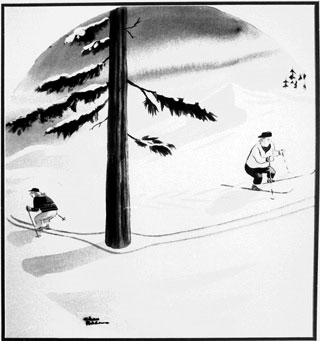
There are two obvious rules for skiing trees: Skiing among trees can provide great fun and is often where the powder is skied last. A variety of experiences can be had, for instance, taking a ride down the snow-covered length of a long log and off its lower end is an option. If the snow is softer among the trees, then adequate speed must be maintained in order to make turns of varying shape, for continual adjustment to turn radius is required and enough momentum must be present to keep the turns going. All your skills will come into play as you select, then reselect the best tactic for the moment. Often you will hear the advice to look the white spaces else your vision will draw you into the darker object you may be wanting to avoid. Many believe this to be so, but even if not completely true, try looking at the white to see if it works for you. Difficulties in skiing among trees are that spacing may vary, snow conditions may be changeable, humps may be over downed tree trunks, broken stumps or stubs may trip you, hollows may be where trees have fallen, tree wells may be around trees where the snow has melted or blown out (possibly with softer snow refilling the pocket), broken-off branches may stick out from the trees, visibility ahead will be limited. You know the old poser, "If a tree falls in the forest, does it make a sound?" If you fall alone in the forest, will you be able to make a sound loud enough to be heard, for you may not be seen. Do not ski in there alone! A final word: Eventually, after selecting the tactic to apply, you must "Point the skis down the hill; let them buck; the mountain will teach you!" Contents of "TACTICS FOR TERRAINS and SNOW
TEXTURES and RACING":
This "Skiing Trees" page last modified February 20, 2025. Did you come here from a link on another website? For latest version of this page, copy to your browser: http://www.SkiMyBest.com/skitrees.htm. Copyright © 2013, 2014, 2015, 2016, 2017, 2018, 2019, 2020, 2021, 2022, 2023, 2024, 2025, 2026. William R Jones |
|