|
Has
"Ski My Best" been of use? Help keep it going:

| |
Did you come here from a link on another website? See page bottom for latest version of this page.
This site is not associated with any ski area. Use of any page
means you accept the SkiMyBest Site Use
Agreement or
EXIT NOW.
 "SKIING
IS A SLIDING SPORT":
"SKIING
IS A SLIDING SPORT":
Tactics for Terrains and Snow Textures and Racing--
Skiing Hard Snow/Ice
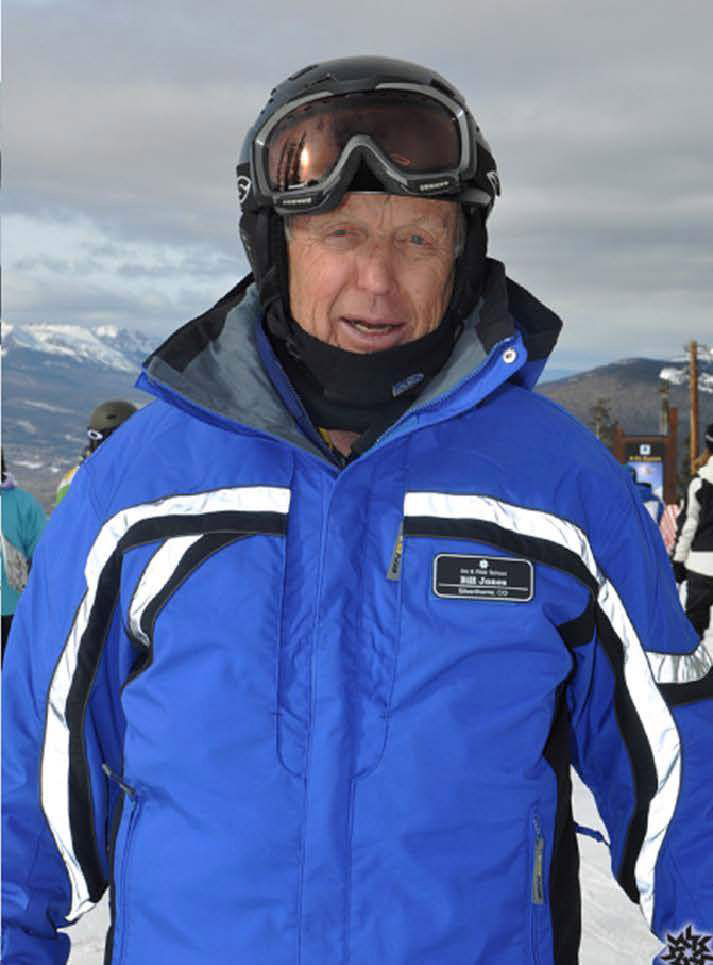
by Bill Jones, Ski Instructor
Certified Professional Ski Instructor (Registration
#110478), Level III
How To Reserve Private Ski Lessons with Bill Jones
In the West, skiers often complain of icy ski slopes. Eastern skiers scoff at
this, for to them ice is like what you put in a cocktail drink. They brag of
reading a page of The New York Times over which they have stopped, frozen
under a layer of clear ice. Western snow can be hard, too, and is occasionally ice if there has
been a long snow-less spell with repeated freezing and thawing. Continual
skier/boarder traffic over a ski slope can also produce an icy snow surface, as
with each passage of a slider the snow's crystal delicacies are melted only to
freeze again after the slider passes. Another ice situation occurs where a
groundwater spring seeps up into the snow and freezes. And there can be a
surface stream that has run amok or a broken water line for a snow gun that
spews water that then freezes on the slope, or the gun itself could have been
badly calibrated or malfunctioned and generated the wrong mix of water and air that then
sprayed onto the slope and froze.
A tactic for ice is to avoid it when you can, or be a racer and love it for
the speed and predictability it will give you. Ski edges that are smoothly filed and with a smaller
base edge bevel and a larger side edge angle may help, creating bevels on base
and side that generate an overall corner that is more acute and therefore slices
into the ice more. For ice, ski bases should
have no convexity that would make edging less sure, although some add a slight
concavity to the base so the edges touch the snow more than the base. (See Ski Equipment/Ski
Edges for a fuller discussion of edge bevels and edge maintenance.) Some skiers use skis that are stiffer
longitudinally for ice, but all should prefer skis that are stiff laterally so the ski
holds firmly when tipped. Boots should be firm and buckled well, and power
straps should hold boot liners firmly against shins. Pole tips should be sharp
so they will not slip when touched on the surface.
If the slope is partly hard snow or ice and partly softer snow, use the
softer areas for as much of your turns as you can; your skis' edges will grip
there better, and drift with flatter skis across the icy areas. If a large patch of ice occurs and
your edges slip out, you can either go faster and edge harder so your skis
will slice into the ice and hold, perhaps adding more weight to the outside ski (the racer's choice) or reduce your edge angle
and drift across the hard surface, maintaining a balanced stance with taut core
and legs. Firm but
progressive movements of the body are vital, for more rapid or forceful
movements are likely to break the skis from whatever edge grip they may have
attained and cause the skis to skid more.
Here is an analysis sent to one skiing associate who was having trouble
managing his speed on steep and slick narrow corridors:
I know I didn’t make clear what I was getting at in suggesting a way to
solve your need to control speed in descending narrow slick spots while
alpine skiing. And I’ve not addressed this adequately on SkiMyBest.com but
this report to you inspires me to add something there... So I hope you’ll
let me try again to explain a way to control speed in that situation. I know
you know most of this explanation already, but perhaps I can put it here in
a way that ties it more together. Know, too, that this explanation applies
mainly to when headed down the fall line. If descending at an angle to the
fall line, such as on a wider slope or on a narrower trail that slants
downward instead of going down straight, you can make a bunch of skiddy sort
of half-turns, creating a garland pattern as your skis scrape the snow, in
sort of rounded sideslips.
The basics are that besides falling over there are only two ways to slow
skis. One is to turn them so they point less downhill and begin to carry the
skier at an angle to the fall line or even uphill (or just head up a reverse
slope). And the other is to increase the friction on the skis.
Imagine a 1x4 piece of wood about as long as a pair of skis that is sliding
with its long dimension pointed straight downhill. Of course it would be
top-heavy if it slid on the 1 inch side so it will be sliding flat to the
snow. But even in this position if it is turned (rotated) so its length is
no longer pointed straight down the fall line but at an angle thereto, the
1x4 will keep sliding the same direction and as fast, as the same amount of
surface is still in contact with the snow and therefore the friction on it
must be the same as before it was turned. Recall the board is still flat to
the surface it is sliding down. There is thus a difference in where the 1x4
is pointed and where it is going (rather like an airplane at takeoff,
climbing with the fuselage pointed at an angle steeper than the line the
plane itself is following). In order to change where the board is going a
deflecting force must occur. This could happen from an irregularity in the
surface on which it is sliding, a little bump or twig or the like that slows
one side and perhaps lifts the other, so that now a slight change in
direction and angle to the surface have occurred and the uphill edge of the
board digs a bit into the surface and starts to scrape sideways over it,
creating more friction that slows that side still more, thus creating a
rotational force, and at the same time causing the board to begin sliding
more along its uphill side that is now touching the surface more than the
rest of the board. The more the board tips, the greater the friction on the
edge of the board that is on the surface, and there will be a variable blend
of how much scraping versus how much change of direction might occur. Thus
when the board became pointed a new way it did not actually change where it
was headed until something deflected one side of it, causing the board to
get on its edge and enhance the deflection. Steel edges on the board would
increase the effect. If the board was shaped like a narrow-waisted popsicle
stick, as the board tipped it would grab more at its leading and trailing
ends and possibly bend into a bow, creating an arc that the board would
follow to the degree that the board tracked on its edge versus skidded on
its edge. The more the board tipped, the higher above the surface would be
its narrower middle and so the more the board could deflect into a stronger
bow and therefore a tighter turning arc.
We skiers can influence what happens to our “boards” by how we position
and/or move our bodies above them, and thus we can manage what our boards
(skis) will do. Thus, rather than waiting for a chance deflection to occur,
we can turn the direction our skis point by applying turning forces. We
should want to do this in a way that allows us maximum options and
flexibility of timing, yet adequate force for the amount of turning we want
the skis to get. Most skiers do this by rotating their entire bodies around
a vertical axis, causing the skis to turn. Another way is to just turn the
lower part of the body down closer to where the skis are in contact with the
snow, which reduces some of the “slack” in the former way and thus makes the
application of the turning force more precise, stronger, controllable,
quicker—and even stoppable, as once a rotation force gets started we need
also to have a way to slow it up and/or stop it. To do this a method of
movement has been developed and was analyzed by Georges Joubert of France.
His work was brought to America in part by Ron LeMaster (who is now a
consultant to the U.S. Ski Team and has books of his own and with whom I
have skied a few times and is probably in Sochi right now). The movement is
called bracquage, and involves rotating the femurs inside the pelvis either
independent of one another or in sync. It is argued that the femurs must
rotate independently in order to keep the skis parallel in a turn, for the
radius followed by the inside ski of a turn is not as long as that followed
by the outside ski; thus the inside ski must be turned more. This is not
possible to do if a person rotates the whole body and is especially does not
work if in a narrow ski stance, just because of some anatomy. The effect of
the different radii on the turning skis varies with the width of the turn,
becoming greater with shorter radius turns and thus more important to use
bracquage in shorter radius turns than longer, ‘though important in both.
It’s not that you have to ski with bracquage, it just gives better
management of the skis in more conditions.
But in order to point the skis in a new direction using rotational forces
that we apply to them, the skis should first be flat to the snow just as in
the example with the board because that if either the board or the skis are
tipped before we apply a turning force, the edges will catch and impede the
turning. Most skiers resolve this problem by just applying more force but
that reduces how quickly they can turn the skis and also creates a need to
subdue the excess rotation a bit later in the turn.
In order to get the skis flat to the snow, we must stand with the forces of
our weight coming down perpendicular to the skis; if we tip so our weight
comes down differently, the skis will also tip--because of the lateral
stiffness of our ski boots. If our boots had no lateral stiffness we would
be much more likely to stand so our weight force is perpendicular to our
skis, and this is why experts and racers sometimes ski with their boots
unbuckled or lightly buckled, so they can improve their feel for this
balanced position. This is not to say we should always be balanced, for
moving out of balance is one way to place new forces on the skis and get
them to do new things. (This point is mine alone, heresy in ski instruction
where you are told to always be in balance; if you don’t do some move, no
new forces will be applied to skis and they will keep doing what they were,
not necessarily what you want.)
Thus with skis flat to the snow we can initiate our turns more quickly and
more precisely and as the turns develop and accelerate downhill and the skis
because of their design sidecut begin to turn themselves, the skis will
naturally catch (“edge”) on their uphill sides because our bodies have been
“left behind” slightly uphill from a vertical line above them, and we are
thus tipping them more. We can control how much we tip them, too, which will
influence how much they scrape their edges on the snow versus follow along
the lines of their arcs as they bend more. We give ourselves better options
for tipping by flexing our legs so we can move the knee (eversion) more to
the inside of the turn and even by pressing the knee (some people say the
foot) with our muscles down toward the snow (press the little toe down, lift
the big toe up is another way this is said).
The end result is a way to create more friction to better maintain the speed
desired on slick snow where there is little maneuvering space. There are
even drills to help develop the skill described. The drills are needed, for
folks do not normally use their legs in the way of bracquage. An old classic
drill is to ski with poles held horizontally in front and at comfortable
arms’ length while skiing straight down a gentle slope at the same time
keeping the poles perpendicular to the fall line. If one turns the hips one
cannot do all this, so one must rotate the femurs inside the pelvis to
succeed. A more advanced form is to start on a smooth low-blue slope, go
straight down a yard or so standing perpendicular to your skis (the body
necessarily tipped outward from the slope) while turning them by rotating
your legs inside the pelvis at the hip joint, bellybutton always pointed
straight down the fall line, flexing downward as the skis come back around
below you and finish their turn, then rising and tipping downhill to
perpendicularity to do it again—all this within a corridor no wider than
your skis are long, or as near as you can. (In instructors’ tests this must
be done in a corridor of ski-length width.) Women tend to be able to do this
better than men because of extra cartilage in their pelvis that makes that
structure more expandable, useful in child-bearing. You can see Mikala
Shiffrin perform the skill of bracquage wonderfully in her slalom racing.
For instance, look at this view from Ron LeMaster:
http://www.ronlemaster.com/images/10-07-2012/. You’ll see her turning
her skis without turning her torso, or as a ballet dance instructor put it
to me, “Always show your pearls to the crowd as much as you can, even while
spinning”. But avoid the trap some fall into, thinking that all turns should
be done with the torso always facing downhill. This is more for
shorter-radius turns which is what will help for slick, narrower descents
(and bumps and slalom races). In longer-radius turns the torso will turn
more with the skis, but it will follow (not lead) the skis as turns are
started using the legs and feet.
So the sequence is get the skis going downhill, get them flat to the snow by
standing perpendicular to them, rotate the femurs in the pelvis at the hip
joint to change the way the skis point, allow the skis to naturally catch
their edges as they will because of their design sidecut, enhance the tip of
the skis by flexing downward so the knee can be bent more and the lower leg
can be tipped at a greater angle to tip the skis still more, getting the
amount of friction desired by how much the skis are tipped, meanwhile with
the skis because of their design arcing to the side and then coming back to
run downhill below you. Then relax and rise up a bit at the same time
allowing the torso (and even the legs if at higher speed) to cross over the
skis so they are to the desired degree on the downhill side of the skis and
do it all over again.
This is not to say that rotation of the whole body does not have a place. In
deep and heavy powder with a variable texture and depth it is difficult to
get in just the right balance position so the forces from the weight of our
body is perpendicular to the skis, tracking as they are on their own
“surface” that develops from the forces they produce on the varying textures
of the powder and which phantom surface holds them at a relative depth in
the snow. And if one misses that position of balance and the skis won’t
turn or turn well enough, one can rotate the whole body without concern of
over-rotating as on a groomed-snow surface, for the resistance of the deep
snow will stop the rotation. I was failed at certification exam once because
the examiner did not understand this principle and did not accept the
rotation I applied. Folks using the terrain parks, too, start many maneuvers
with a whole-body rotation before they leave the snow for one cannot create
the spin needed once launched. Likewise with the confused examiner just
cited, the ski instructors’ association had advocated against any such
rotation until the kids in the terrain parks showed what it could do. You’ll
even see Olympic racers using the technique in speed events when they want
to get from one set of edges to the other in a fast way or in the slaloms
for the same reason or to correct a slight miscalculation or prior bobble
that kept them from not starting a turn soon enough. Then these racers stop
the excess rotation by a hard edge set and a blocking action of the muscles.
(This is much the same as I learned in the old-school method of throwing a
discus in which you first spun and then just before releasing the platter
you braced the inside foot with core tension, stopping rotation on that side
and allowing the outside of the body to spin a bit more, theoretically
adding impetus to the throw --now discredited, however, even though the move
is useful in skiing and possibly some other areas).
And you are right, clean edges are a requisite for control on slick spots,
but also consider different edge bevels. Manufacturers recommend base bevels
from ½ to 1 degree and side bevels usually in the 1 to 2 degree range, but
the recommendations are also specific to their particular models. And even
then these recommendations are general purpose. Because you have a specific
concern, you might experiment with your own choices for bevel. Racers often
use a 3 degree side bevel, and I have come to that. Sometimes bevels are
varied along the length of the edge, depending on what part of the ski’s
length one wants to have more effect. Before rocker skis were invented, for
instance, we got much the same effect of the upturn at either or both tip
and tail by sometimes having a lesser base bevel in those areas compared to
what we had in the underfoot region. Because the bevel does not have much
effect except on groomed-snow areas and even there it has more effect on the
hardest areas, you normally needn’t be much concerned with an effect in
softer snow. But don’t overlook the importance of developing the bracquage
technique, too. Clean and beveled edges are not worth as much without
bracquage, or vice versa. (I also have a bit of a discussion on edge angles
at
www.skimybest.com/skiequip.htm, and there may still be more in the
Tognar Toolworks catalog, if still available by requesting online at that
name.
A final word: Eventually, after selecting the tactic to apply,
you must "Point the skis down the
hill; let them buck; the mountain will teach you!"
Contents of "TACTICS FOR TERRAINS and Snow
Textures and Racing":
Overview
Skiing Groomed Snow
Skiing Hard Snow/Ice--you are on this page.
Skiing Among Trees
Skiing Narrow trails
Skiing Moguls
Skiing Powder Snow
Skiing Cold Snow-Warm Snow/New Snow-Old Snow
Skiing "Spring" Snow
Skiing Steeps
Skiing Gates/Racing
"SKIING
IS A SLIDING SPORT"--a skiing web manual: Skiing
Web
Manual Contents Why Read
This Skiing Web Manual That First Skiing Lesson A
Little Skiing History
A Little Skiing History Motion
in Skiing
Conventional Skiing Wisdoms
Skier Excuses Fear
in Skiing
Conditioning for Skiing How Skis
Work
Equipment and Technique
Skiing Equipment
How
to Develop Balance on Skis
A Skiing Turn
Simplified The Final Skiing Skill:
pressure management TACTICS FOR TERRAINS and SNOW
TEXTURES and RACING
Skiing Tips and Tales--a potpourri
Exercises for Developing Skiing Skills
Children and Skiing
Gender & Skiing Age and Skiing
Culture & Skiing Skiing Ethics and Slope Survival
Slope Safety Skiing
Environment Videos and Apps Glossary Acknowledgements
SkiMyBest Website Contents
This "Skiing Hard Snow/Ice" page last modified
November 17, 2021
. Did you come here from a link on another website?
For latest version of this page, copy to your browser: http://www.SkiMyBest.com/skihard.htm.
Copyright © 2013, 2014, 2015, 2016, 2017, 2018, 2019, 2020, 2021, 2022, 2023, 2024, 2025, 2026. William R Jones
| |
|