|
Has |
Did you come here from a link on another website? See page bottom for latest version of this page.
Can you put on a sock while standing on one foot? And likewise while standing on the other foot? If so, you likely have the balance to ski well. If that is too hard, try putting on a pair of pants while standing on each foot; that may be enough for most of us!
Objectives of skiing in a balanced stance are two-fold: 1) You will have more options to move into slightly out-of-balance positions to cause the skis to perform as you wish in special situations, and 2) because you will be able to use the skis more to cause your turns rather than your muscles, you will have more strength to effect the most efficient movements, and you will also be able to ski more hours in the day, more days in the ski vacation, more weeks in the ski year, and more years in the ski lifetime. Muscle tone and practice are where balance come from. Body mechanisms such as inner ear devices may also play a role, but we pretty much have to use what we already possess within that area. Skiers can exercise off the slopes to tone muscles. They can do daily chores like putting on socks while standing on one foot. Or they can walk a rail or stand on one foot on the top of a short post. There are also balance boards which consist of a slotted drum and a board with a rail that slides along the slot as the drum rolls and the skier stands atop the board. To learn balance on skis while on a slope, however, will probably require some special exercises and a degree of "I can do it" commitment. Humans have a natural tendency to seek the vertical position. But to be balanced against the forces of a ski turn, a skier often must be oriented off the vertical. Many skiers must be coached and coaxed into this new feeling. One simple tip, however, is to keep the eyes up so that landscape elements (trees, horizons, posts) give references to where horizontal and vertical lie. Looking up also helps you see where you are going and gives you more time to plan your course and reactions. (One instructor asked for a bottle of wine every time a student looked down, and was owed probably a freight-car load by winter's end, although he didn't collect any.) Lightly touching or dragging a ski pole along the snow surface, like an antenna, can also give a feel for slope angles and one's positioning. Of course, skiers wishing to improve balance should not push beyond the upper limit of their comfort or reality zones. That is usually counter-productive and results in substitution of moves that presently seem more comfortable than the ones that need to be learned. Instead, pick slopes that are not so steep as to inhibit making the needed moves. Then practice on similar terrain until ready to try the next degree. Eventually on really steep slopes, the needed move seems like a dive down the hill to get into the balanced position. In fact, one is surely out of balance while making some moves, for it is necessary to apply new forces to skis than the ones that keep everything centered--else the skis won't do anything new. One student called the turn so effected a religious turn; "It takes faith," he said, "to move into the scary position so the skis will turn. But it works!" (See more on this "out-of-balance" move on the page "How Skis Work..." and go down to the section "Should we ever be out of balance?") Way to feel the position of leaning into a turn:
Here is Dick Durrance, skier from the 1930s known as "The Man on the Medal"
because his racing form was copied on trophy medallions awarded at top U.S.
races. See how he dives down this steep
slope, his overall form actually forward on his skis (a bit too forward and
low for today's standards.) In this position he can more effectively use
all his joints and his weight is distributed along the skis; imagine his problem
if he kept his body vertically align There is also the "upside-down turn" used by some top racers, in which the dive down the hill is so extreme their heads are below their skis! For most of us, that is too much. But it works at the proper speeds. There is a big word that pertains to balancing: proprioception. It relates to feeling one's muscles and the positions of one's body parts internally. We all know what it feels like when we touch an object. There is also an internal sensation we get when we tense a fist or an arm, for instance. Try it. Even try tensing a leg as you might in skiing. Becoming aware of these proprioceptive sensations helps us fine-tune our muscles so that we hold body elements--especially legs and feet but the abdominal core and arms as well--in position or as we move them among positions. Holding muscles tautly but not tightly will hold our skis the same way so they can perform for us with precision.
[A note from Horst Abrams of Vail Solutions posted on PSIA Open Forum Digest for December 20, 2016: " I would suggest that any motion is initiated by movement with which we trade temporary imbalance for the benefit of getting from 'here' to 'there'. Whether we examine this principle in the process of walking, bike riding or skiing, seeking temporary imbalance is the starting point, validating the concept of requiring movement to allow for motion. This is why the good Lord gave us a spine and joints and proprioception to orient ourselves in space and sense what our limbs are doing in relation to each other. It is for that reason that I question the relevance of teaching 'stance' as a means to improve 'balance'. Balancing requires movement. Taking the risk of being redundant, please absorb the profound simplicity of Buckminster Fuller's wisdom when he suggests that: "Inherent in balance is motion; inherent in motion is balance" - Now that is 'KISS', not the 'kiss' [ed.: keep it simple, stupid] we tend to often operate from."]
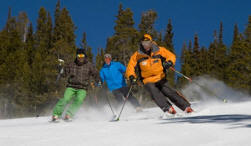
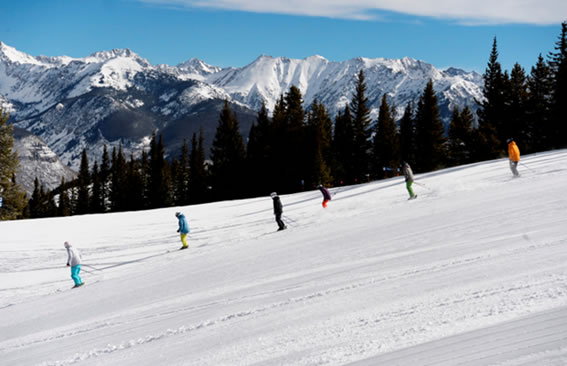
Few or none of these skiers are aligned perpendicular to the ski slope although to their credit they are tipped a bit forward from vertical. All have their hands down at their sides; some have their hands toward the back. Thus, they are not balanced over the length of their feet or their skis. To get in balance, they need to bring their hands up to waist height and forward with their elbows in front of the hips. Having the hands apart 2 to 3 feet when in the up and forward position will allow them to be better balanced side-to-side and make adjustments by moving a hand in or out or up or down as needed. Simple? Then why do most skiers ski like the folks in the picture?
This skier really needs to be in balance skiing in chopped-up snow with a spongy surface: He does this with hands up, forward, and held
 "SKIING
IS A SLIDING SPORT"--a skiing web manual: Skiing
Web Manual Contents
Why Read
This Skiing Web Manual That First Skiing Lesson
A Little Skiing History
Motion in Skiing
Conventional Skiing Wisdoms
Skier Excuses Fear in
Skiing
Conditioning for Skiing How Skis
Work
Equipment and Technique
Ski Equipment
How Skis
Work
HOW
TO DEVELOP BALANCE ON SKIS
A Skiing Turn Simplified
The Final Skiing Skill: pressure management Tactics for Terrains and Snow
Textures and Racing
Skiing Tips and Tales--a potpourri
Exercises for Developing Skiing Skills
Children and Skiing
Age and Skiing
Gender & Skiing
Culture & Skiing
Skiing Ethics and Slope Survival
Slope Safety Skiing
Environment Videos and Apps Glossary Acknowledgements
SkiMyBest Website Contents "SKIING
IS A SLIDING SPORT"--a skiing web manual: Skiing
Web Manual Contents
Why Read
This Skiing Web Manual That First Skiing Lesson
A Little Skiing History
Motion in Skiing
Conventional Skiing Wisdoms
Skier Excuses Fear in
Skiing
Conditioning for Skiing How Skis
Work
Equipment and Technique
Ski Equipment
How Skis
Work
HOW
TO DEVELOP BALANCE ON SKIS
A Skiing Turn Simplified
The Final Skiing Skill: pressure management Tactics for Terrains and Snow
Textures and Racing
Skiing Tips and Tales--a potpourri
Exercises for Developing Skiing Skills
Children and Skiing
Age and Skiing
Gender & Skiing
Culture & Skiing
Skiing Ethics and Slope Survival
Slope Safety Skiing
Environment Videos and Apps Glossary Acknowledgements
SkiMyBest Website Contents This "How To Develop Balance on Skis" page last modified April 11, 2024. Did you come here from a link on another website? For latest version of this page, copy to your browser: http://www.SkiMyBest.com/skihowba.htm. Copyright © 2013, 2014, 2015, 2016, 2017, William R Jones. |
|

 See
how they lean? Why don't they fall over?
See
how they lean? Why don't they fall over?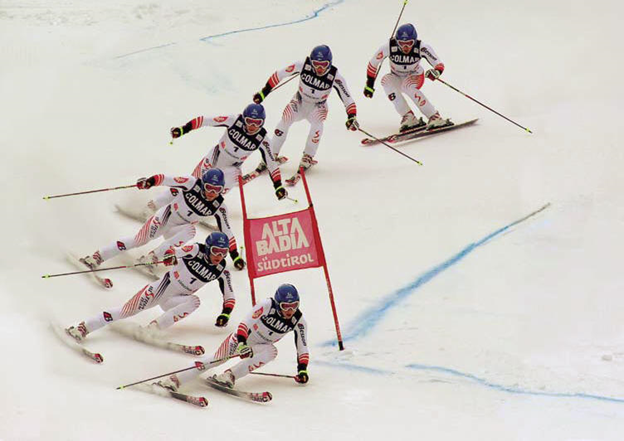
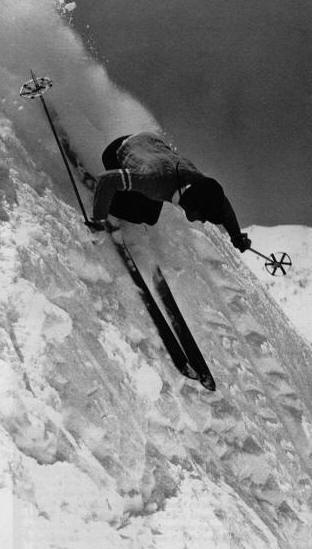
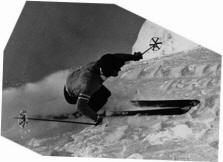 ed while going down such a steep slope! He
would almost be lying flat backwards on his skis. His ski tails would dig into
the snow from his weight there and he could not turn. The inset on the right shows the same
photo of Durrance but rotated as if the skis were on a flat. from
Skiing Heritage magazine 3rd issue 2010.
ed while going down such a steep slope! He
would almost be lying flat backwards on his skis. His ski tails would dig into
the snow from his weight there and he could not turn. The inset on the right shows the same
photo of Durrance but rotated as if the skis were on a flat. from
Skiing Heritage magazine 3rd issue 2010. 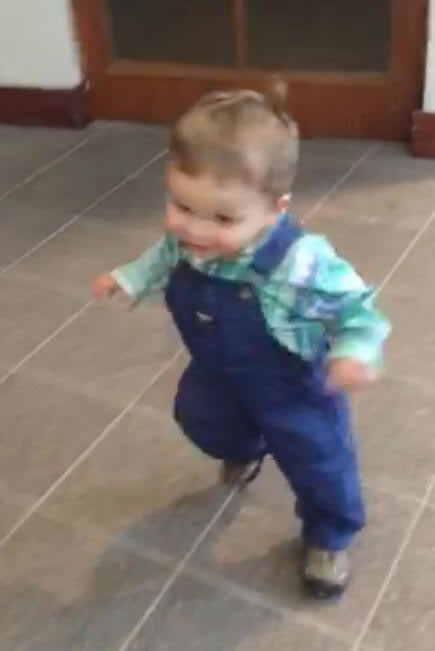 Finally,
consider the notion many skiers have that one should always be in balance while
skiing. If they are, they will keep on skiing in whatever direction they are
headed. To change direction (by turning the skis or changing the angle of their
skis' tilts, one must first move out of balance. The same need occurs in walking
and running: If one is in balance, one goes nowhere. One must first tip forward,
then, as one would otherwise fall, a leg is swung forward so that a foot lands
ahead and keeps us from falling. We get so good at this that we can move
continually. But see this little guy learning how, seemingly ready to topple
over forward but instead moving where he wants to go.
Finally,
consider the notion many skiers have that one should always be in balance while
skiing. If they are, they will keep on skiing in whatever direction they are
headed. To change direction (by turning the skis or changing the angle of their
skis' tilts, one must first move out of balance. The same need occurs in walking
and running: If one is in balance, one goes nowhere. One must first tip forward,
then, as one would otherwise fall, a leg is swung forward so that a foot lands
ahead and keeps us from falling. We get so good at this that we can move
continually. But see this little guy learning how, seemingly ready to topple
over forward but instead moving where he wants to go. Runners
at race starts tip their bodies far forward, balancing on their hands until the
starting gun when they spring out and swing a foot forward. Whenaccelerating, runners appear to be more out of balance, as in this relay race where those who have just been passed the baton are tipping forward.
Once underway, the body is more upright and in better balance with the forces on
it but because
Runners
at race starts tip their bodies far forward, balancing on their hands until the
starting gun when they spring out and swing a foot forward. Whenaccelerating, runners appear to be more out of balance, as in this relay race where those who have just been passed the baton are tipping forward.
Once underway, the body is more upright and in better balance with the forces on
it but because 
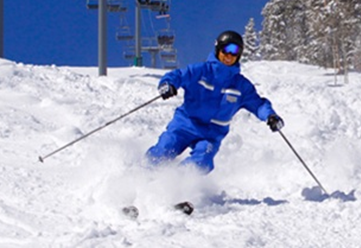 wide apart--and with his legs and feet and skis apart, giving him a bigger platform of support and a way to adjust his top to keep the weight even on his feet. His core must be tensed to maintain this position and if it is he can also extend or retract a leg to rebalance. He also tips his body inward toward the center of the turn he is in (he is turning to his left, toward the right side of the picture) but he then must move across the skis to their other sides to effect a new turn and then tip into the center of that one. If he did not so tip the force of turning would throw his body outward and he would no longer be blue but mainly white.